
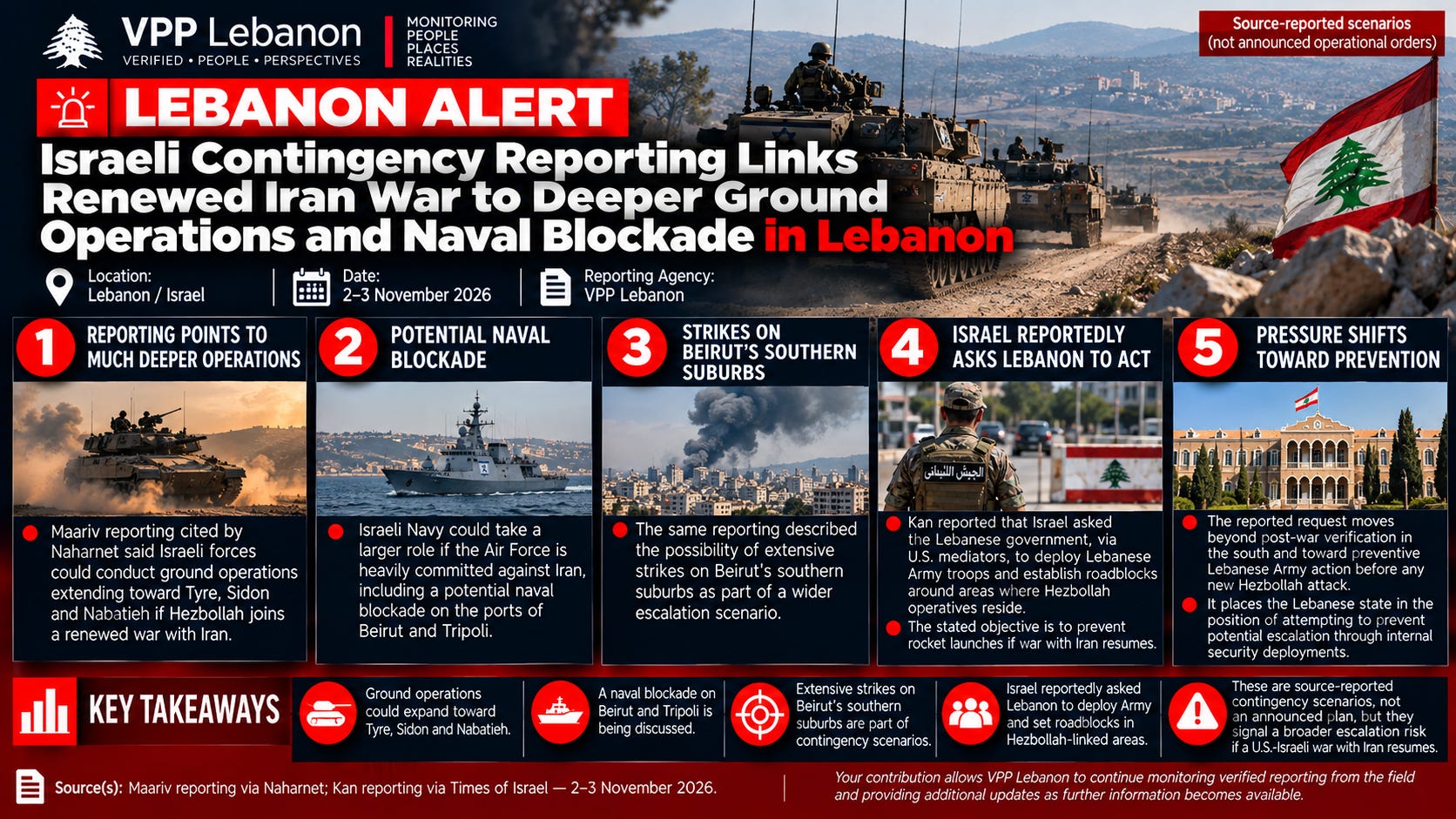
Israeli media reporting has outlined a contingency scenario in which a renewed U.S.-Israeli confrontation with Iran could trigger far deeper Israeli military operations inside Lebanon if Hezbollah joins the conflict.
Maariv reporting cited by Naharnet said Israeli planning could include ground operations extending toward Tyre, Sidon and Nabatieh, while the Israeli Navy could take a larger role if the Air Force were heavily committed against Iran. The same reporting described the possibility of a naval blockade on the ports of Beirut and Tripoli and extensive strikes on Beirut’s southern suburbs.
These are reported contingency scenarios, not announced operational orders.
Reporting Points to Much Deeper Ground Operations
The reported scenario would represent a substantial expansion beyond the current Israeli military footprint in southern Lebanon.
According to the Maariv-derived reporting, Israeli forces could seek to move toward or take control of Tyre, Sidon and Nabatieh if Hezbollah entered a renewed regional war alongside Iran.
Separate reporting citing U.S. diplomatic sources described an even broader scenario involving operations north of the Awali River, alongside pressure on Beirut’s airport and major ports. Those claims remain source-reported and have not been publicly confirmed as an approved Israeli operational plan.
Israel Reportedly Asks Lebanon to Block Hezbollah Movement
In a separate development, Israel reportedly asked the Lebanese government through U.S. mediators to deploy Lebanese Army troops and establish roadblocks around areas where Hezbollah operatives reside, with the stated objective of preventing rocket launches if war with Iran resumes.
Kan, citing an Israeli security source, reported that the request was conveyed through Washington and accompanied by a warning that fighting in Lebanon could resume if Hezbollah attacks Israel.
The reporting did not establish that Beirut accepted such a request or agreed to the proposed deployment pattern.
Pressure Shifts Toward Lebanese State Prevention
The Kan report is significant because it moves beyond Israeli demands related to post-war verification in southern pilot zones and toward a request for preventive Lebanese Army action before any new Hezbollah attack occurs.
The reported proposal would place the Lebanese state in the position of attempting to prevent rocket launches through internal security deployments and roadblocks in areas associated with Hezbollah personnel.
It also intersects directly with Beirut’s existing position that security concerns should be handled through official institutions and established coordination mechanisms, rather than renewed military escalation.
What This Signals
The reporting should be understood primarily as risk signaling and contingency planning, not evidence that a new operation has been authorized or is imminent.
However, the scenarios being discussed are materially more expansive than current military activity in South Lebanon.
They encompass three separate dimensions:
deeper ground penetration toward major southern cities,
potential maritime pressure on Beirut and Tripoli,
and demands for preventive Lebanese Army action against possible Hezbollah involvement.
This suggests that Israeli security planning is increasingly treating the Lebanon front as part of the wider Iran contingency, rather than as an isolated border conflict.
For Lebanon, the central risk is that a renewed Iran confrontation could rapidly transform the current security environment from localized military pressure in the south into a much broader national conflict involving major cities, ports and transport infrastructure.
Source(s): Maariv reporting via Naharnet; Kan reporting via Times of Israel — 2–3 November 2026.
Full articles / sources:
Naharnet — Israel plans to occupy Tyre, Sidon and Nabatieh if Hezbollah joins potential Iran war