
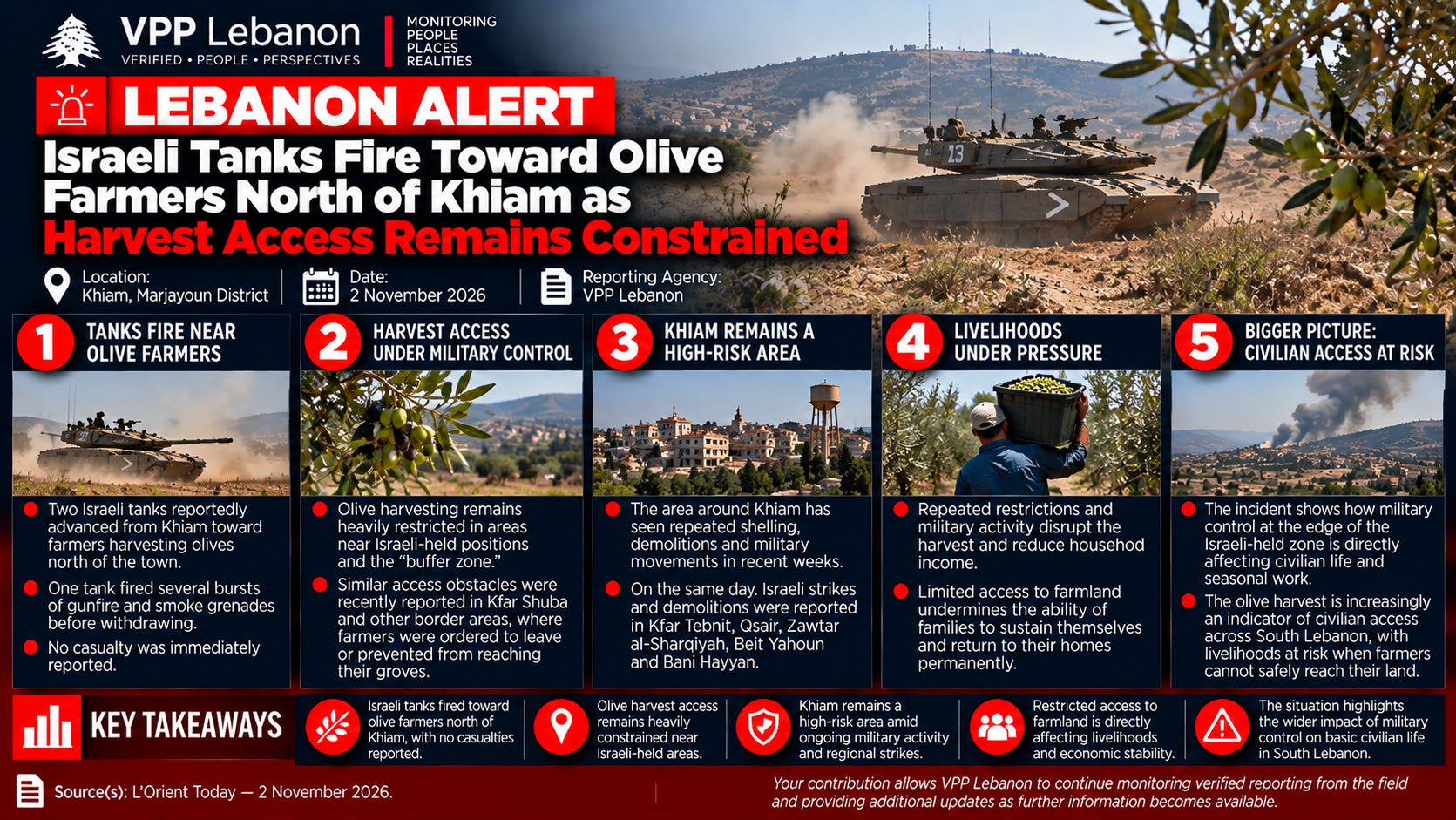
Two Israeli tanks reportedly advanced from Khiam toward farmers harvesting olives north of the town on Monday before opening fire in their direction and later withdrawing. No casualty was immediately reported.
one of the tanks fired several bursts of gunfire and smoke grenades before returning toward the Israeli-occupied area around Khiam. The incident occurred along the edge of the Israeli-controlled “buffer zone,” where access to agricultural land remains heavily restricted.
Olive Harvest Increasingly Intersects With Military Control
The incident highlights the practical impact of the current territorial situation on civilian livelihoods.
Olive harvesting is one of the most important seasonal activities for many South Lebanon communities, but access to groves near Israeli-held areas has repeatedly required coordination or has been prevented altogether.
Recent reporting has documented similar restrictions around Kfar Shuba, where farmers attempting to reach olive groves were ordered to leave by Israeli troops, as well as other border areas where access has been limited by active military positions and fire.
Khiam Remains a High-Risk Access Area
The area around Khiam has experienced repeated shelling, demolitions and military movements in recent weeks.
The November 2 incident occurred on a day that also saw Israeli strikes and demolitions across several parts of South Lebanon, including Kfar Tebnit, Qsair, Zawtar al-Sharqiyah, Beit Yahoun and Bani Hayyan.
This broader context makes agricultural access around Khiam particularly sensitive, as farmers can find themselves operating close to active military positions and areas where artillery, demolitions and ground movements continue.
What This Signals
The incident illustrates how the edge of the Israeli-controlled zone is affecting civilian life even where residents are attempting to carry out ordinary seasonal work.
For farming communities, the issue is not simply whether agricultural land remains physically intact. The ability to reach that land safely is becoming equally important.
Repeated restrictions, military patrols and direct fire around farmland can disrupt the harvest, reduce household income and weaken the economic conditions needed for displaced families to return or for remaining residents to sustain themselves.
The olive harvest has therefore become an important indicator of civilian access across South Lebanon: where farmers cannot safely reach their land, military control is translating directly into livelihood loss.
Source(s): L’Orient Today field reporting — 2 November 2026.
Full article / source:
L’Orient Today — Israel targets farmers harvesting olives north of Khiam, carries out extensive demolitions in Zawtar Sharqieh